
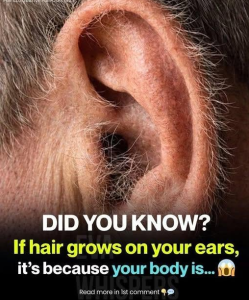
ears—especially as you age—you’re not imagining things. And while it might seem like a quirky (or annoying) part of getting older, ear hair can actually offer subtle clues about your overall health, particularly when viewed alongside other symptoms.
Let’s separate myth from science.
🧓 1. Ear Hair Is Mostly a Normal Sign of Aging
Why it happens: As we age, hormone shifts—especially increased sensitivity to testosterone—can cause hair to grow in new places (ears, nose, eyebrows) while thinning on the scalp.
Imbalances
Polycystic ovary syndrome (PCOS) in women: Can cause excess hair (hirsutism) on face, chest, and ears.
Adrenal or thyroid


Comments